




Meishe New MIFX Effect Framework: Turning User Intent into Effects
Meishe has released a major upgrade to its MIFX (Meishe Image FX) effect framework. Rebuilt around a node graph, the new architecture resolves many of the challenges of the legacy effect development workflow and makes developing, optimizing, and shipping effects far more efficient.
Rebuilding the Effect Development Pipeline
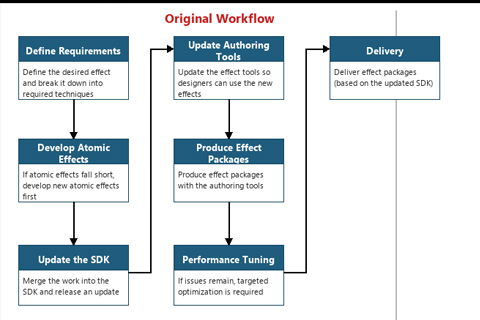
Years ago, Meishe introduced an effect development solution based on “atomic effects plus authoring tools”, letting designers create and apply effects without coding. But because the tools depended on the SDK's atomic effect capabilities, developing a brand-new effect still meant a chain of dependent steps: SDK updates, tool adaptation, performance optimization. That raised the skill bar for effect developers and stretched product development cycles.
The upgraded MIFX framework is built around a node graph and consists of two parts: the MIFX SDK and the MIFX development tools. Effect developers no longer need to handle low-level work such as power optimization or pipeline tuning. Connect nodes, plug in effect algorithms, or reuse existing SDK atomic capabilities - and a new effect goes from idea to production quickly.
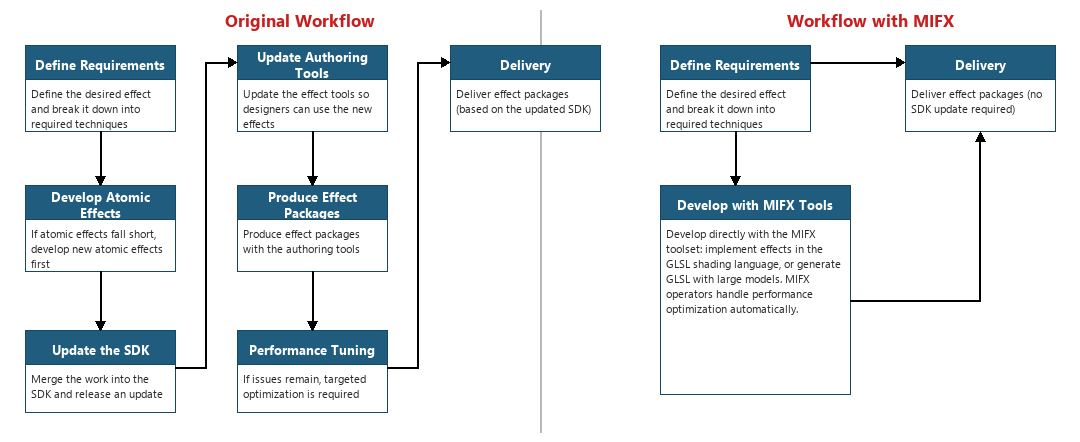
Effect Development Workflow Comparison
Core Advantages of the New MIFX Effect Framework
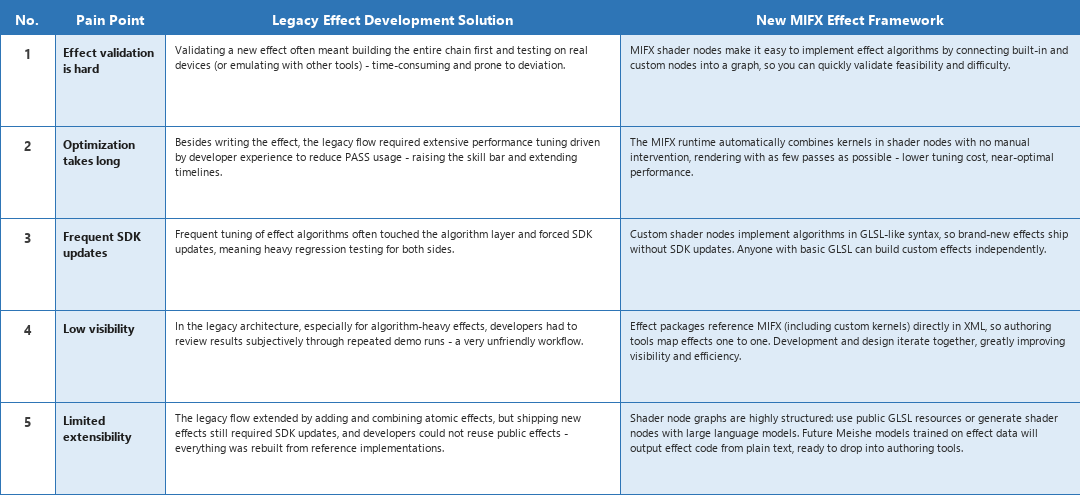
Addressing the pain points of the legacy solution, the new MIFX framework solves long-standing effect development problems at the architectural level.
AI-Powered: Turning User Intent into Effects
The upgraded MIFX framework streamlines the existing workflow and can also convert general-purpose GLSL into SDK node operators automatically, enabling large-model-generated effects and opening the AI era of effect development.
STEP 1: Developers build effects with large models
Developers can generate GLSL shaders directly with a large model, convert them into node operators through MIFX, and assemble effects right inside MIFX. The time from idea to working effect drops from days to minutes.
STEP 2: Users generate effects with large models
With a large-model agent that understands MIFX logic and the SDK's built-in effects, users can state an intent and have the model generate an entire MIFX effect pipeline with per-node operators. Where no suitable operator exists, GLSL generated by the model can be converted on the fly. This is what “creating effects with words” looks like in practice.
Meishe's upgraded MIFX framework is more than an effect development toolset - it redefines how effects get built. With the node graph at its core and deep integration with large AI models, it unlocks the creativity of enterprise effect developers. It gives smart hardware makers, handset manufacturers, and many other industries an effect development solution that is more efficient, more flexible, and more extensible, so every idea ships fast and user intent becomes an effect.