
Every year brings a fresh set of listicles ranking video editing SDKs. They are easy to skim and rarely useful, because they rank several very different products against one another using criteria the reader did not choose. A team building a ten-second social clipper cares about different things than a team building a desktop-grade multi-track editor inside a broadcasting workflow. When the use cases differ that much, a single ranking mostly reflects whoever compiled it.
So here is a different approach to the same question. Rather than a leaderboard, this article sets out the five criteria that define a top video editing SDK in 2026 — the dimensions along which your own requirements should decide the answer. For each, we describe what to look for and how the Meishe Video Editor SDK approaches it, so you can judge whether our priorities match yours.
1. Product Positioning
Before applying the five criteria, it helps to know what kind of product is being measured. Meishe Video Editor SDK is an all-in-one video editing SDK built on a self-developed video processing engine with a broadcast-grade NLE (Non-Linear Editing) architecture.
It is delivered across iOS, Android, Flutter, React Native, Web, PC, and server rendering, and can be embedded under your own interface or used through ready-made editor products such as the Web Video Editing System, MYVideo App, and MYVideo PC Version. Judge the criteria that follow against your requirements first, and against any vendor second.
2. Criterion 1: Render performance and real-time preview
Performance is where editing products succeed or fail, and “fast” needs decomposing.
Ask whether effects require preprocessing. If applying a filter triggers a background render before the result can be previewed, editing becomes an exercise in waiting, and users stop experimenting. A render pipeline that evaluates effects, keyframes, masks, and transitions at composite time on the GPU avoids that entirely.
Then ask how the pipeline behaves at the top of your source range. Supporting 8K footage and 16K stills is only meaningful if the timeline stays scrubbable while handling them.
Finally, ask about color depth. Mixed dynamic range is normal now: preview HDR, combine HDR and SDR material on one timeline without manual normalization, and export either an HLG or an ST2084 transfer curve.
Where Meishe stands: a self-developed cross-platform video and audio engine with a broadcast-grade NLE (Non-Linear Editing) architecture, real-time effect rendering with no preprocessing stage, support for 8K video editing and 16K image processing, HDR preview, mixed HDR/SDR timelines, and HLG or ST2084 export.
3. Criterion 2: Platform coverage and deployment targets
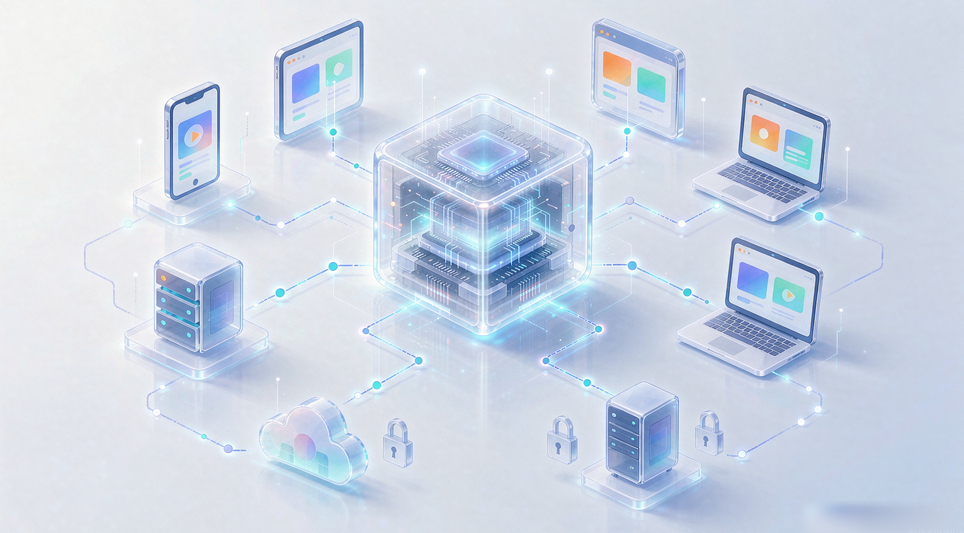
Coverage is not a vanity metric: it decides whether you maintain one product story or several. The useful question is not how many targets are listed but whether they share an engine.
| Target | What to require | Why it matters |
|---|---|---|
| iOS and Android | Full capability parity, hardware encoder access | The baseline for most consumer apps |
| Flutter | Plugin over the native core, texture-backed preview | Keeps UI in Dart without moving pixels across the bridge |
| React Native | Native module plus native view | Same split, with a TypeScript-facing API |
| Web | Browser module able to render the same project data | Enables edit-in-browser flows |
| Desktop (PC) | Deep-editing capability for longer-form work | Serves professional and broadcast use cases |
| Server | Headless rendering of the same timeline | Batch and template-driven output without a second renderer |
Where Meishe stands: the same core is delivered across iOS, Android, Flutter, React Native, Web, desktop, and server rendering, with additional product surfaces available for teams that want a ready-made editor rather than an embedded one.
4. Criterion 3: Depth of the editing model
This is the criterion most often skipped during evaluation, because feature lists look similar from a distance. Depth shows up in whether the SDK can express what your editors will actually ask for.
Look specifically for: multi-track video and audio editing; atomic effects; keyframe animation with editable curves; masks and mattes; subtitles beyond static text — per-character motion, scalable background plates, rich text, and speech bubbles; filters with adjustable intensity; 2D and 3D transitions; timeline effects such as time reversal, repeat, and slow motion; co-creation scenes; an audio chain with real equalization rather than a gain slider; and beauty resources tunable per component.
Where Meishe stands: all of the above are part of the core editing model, including a 30-band equalizer split into low, mid, upper-mid, and high bands, single and combined makeup resources tunable per component, and an effects library you can extend with custom packages.
5. Criterion 4: Integration cost and customization surface
A capability set only counts if your team can actually ship it. Evaluate three things.
First, ownership of the UI. If the SDK insists on rendering its own interface, you will spend your customization budget fighting themes. Prefer an SDK whose only mandatory native surface is the preview window, leaving all surrounding controls in your framework of choice.
Second, projects as data. When a timeline is expressed as serializable data rather than imperative calls, your backend can generate it, your server can render it, and your app can restore it. That unlocks template systems and overnight batch jobs without duplicating logic.
Third, footprint and reference material. A compact core limits app-size impact, and demo code that is structured to be productized shortens the path from evaluation to production far more than documentation alone.
The snippet below is schematic. Module names, method names, and signatures are illustrative and are not the shipped API surface.
// Illustrative: a timeline expressed as data, renderable on client or server.
const project = {
  aspectRatio: "9:16",
  fps: 30,
  tracks: [
    {
      type: "video",
      clips: [
        { uri: "s3://assets/clip-a.mp4", inMs: 0, outMs: 4200, filter: { id: "grade.warm", intensity: 0.8 } },
        { uri: "s3://assets/clip-b.mp4", transition: { id: "diffuse-pixel", durationMs: 480 } },
      ],
      keyframes: [{ property: "opacity", curve: "easeInOutQuad", points: [{ atMs: 0, value: 0 }, { atMs: 400, value: 1 }] }],
    },
    { type: "subtitle", clips: [{ template: "highlight.dynamic", mode: "perCharacter", source: transcriptUri }] },
    { type: "audio", clips: [{ uri: "s3://assets/bed.mp3", eq: { low: 2, mid: 0, upperMid: 1, high: -1 }, mix: 0.6 }] },
  ],
};

// Same object can be rendered in-app or handed to a server render node.
const output = await render(project, { preset: "social-1080p", hdr: "hlg" });
Where Meishe stands: the SDK core is approximately 3 MB, the timeline model is a shared portable description, companion DEMO source code is structured to be productized, and 1V1 support plus downloadable AI Skills for Codex, Qoder, Claude Code, and Cursor shorten the remaining work.
6. Criterion 5: Deployment model, data control, and support
Video pipelines handle user-generated content, which often means personal data that cannot leave a jurisdiction. Ask early whether a vendor supports private deployment, whether any authorization step is required to operate, and how support is delivered.
Where Meishe stands: private deployment is supported, no user authorization step is required to use the SDK, and integration assistance is delivered 1V1. Meishe brings over 20 years of development experience in the field of video and audio, holds more than 70 video-related patents, and has won many national awards. For teams that need more than configuration, Special Effects Customization and custom development are available.
7. Applying the five criteria to your shortlist
| Criterion | What to test | A reasonable pass signal |
|---|---|---|
| Render performance | Build a four-track project with effects and keyframes; scrub it | Preview stays interactive; no preprocessing waits |
| Platform coverage | Build and run your real minimum project on every target you ship | One timeline model, no per-platform reauthoring |
| Editing depth | Try your hardest requirement, not your easiest | It is expressible without a workaround |
| Integration cost | Time from empty project to first export | Measured in days, with your own UI intact |
| Deployment and support | Ask for your compliance scenario in writing | A documented answer before you commit |
Treat the result as a profile rather than a score — the right choice is whichever overlaps most with your constraints.
FAQ
Why not just publish a ranked list?
Because the ranking would depend on requirements we cannot know. A criteria-based approach transfers the decision to the only party with the necessary context: your team.
Which criterion do teams most often underweight?
Integration cost and editing depth. How long it takes to ship a capability, and whether it extends to your hardest requirement, decides the outcome.
Is cross-platform support worth prioritizing if we only ship mobile today?
Usually yes. Web editing and server-side rendering tend to appear later, and retrofitting them onto an engine that never supported them costs more than choosing one that already does.
How should we evaluate claims about performance?
Run the vendor’s own demo against a project built from your real content, on the cheapest device you support, in release mode. Qualitative observations from that run are worth more than any figure in a datasheet.
What if our requirements do not fit the standard modules?
Ask about customization before you buy. Meishe supports custom development and Special Effects Customization, and prefers to scope it honestly upfront.
Ready to see it in your own stack? Request a free trial or talk to our integration team — we’ll help you scope the modules you actually need.