
Rankings age badly and rarely match your product. What holds value is the five properties that separate the strongest video effects SDKs in 2026 — and a concrete answer to each from Meishe, whose effects SDK runs today in camera, editing, and streaming products across platforms.
1. Product Positioning
Meishe provides a video effects SDK built on the cross-platform audio/video processing engine used across the product family, rendering with real-time rendering without pre-processing. The five properties hold on iOS, Android, Web, Desktop (Windows), and smart hardware, and the two cross-framework targets join through the short-video solution. The SDK is the effects layer in your product: beautification, 2D and 3D stickers, filters, segmentation, and gesture interaction, delivered as packages your team controls.
2. The five properties — and Meishe’s answer
| Property | What it looks like in a strong SDK | Meishe’s answer |
|---|---|---|
| 1. Real-time rendering | Effects appear on the live preview the moment the camera opens — no processing step first | Real-time rendering without pre-processing on the shared engine |
| 2. One detection, many effects | Adding a sticker on top of beauty adds no second analysis | One face analysis per frame feeds beautification, stickers, makeup, and gestures together |
| 3. Effects as content | A campaign ships as a data update, not an app release | Packages are data — published through your channel, no store review |
| 4. Device reach | One library holds up from flagships to budget phones | Detection cadence adapts inside the same package across the device matrix |
| 5. Footprint | The SDK earns its MB against your own features | A small core on mobile, optional modules load on demand |
3. Behind the table: what users actually experience
The five properties above translate directly into the camera screen:
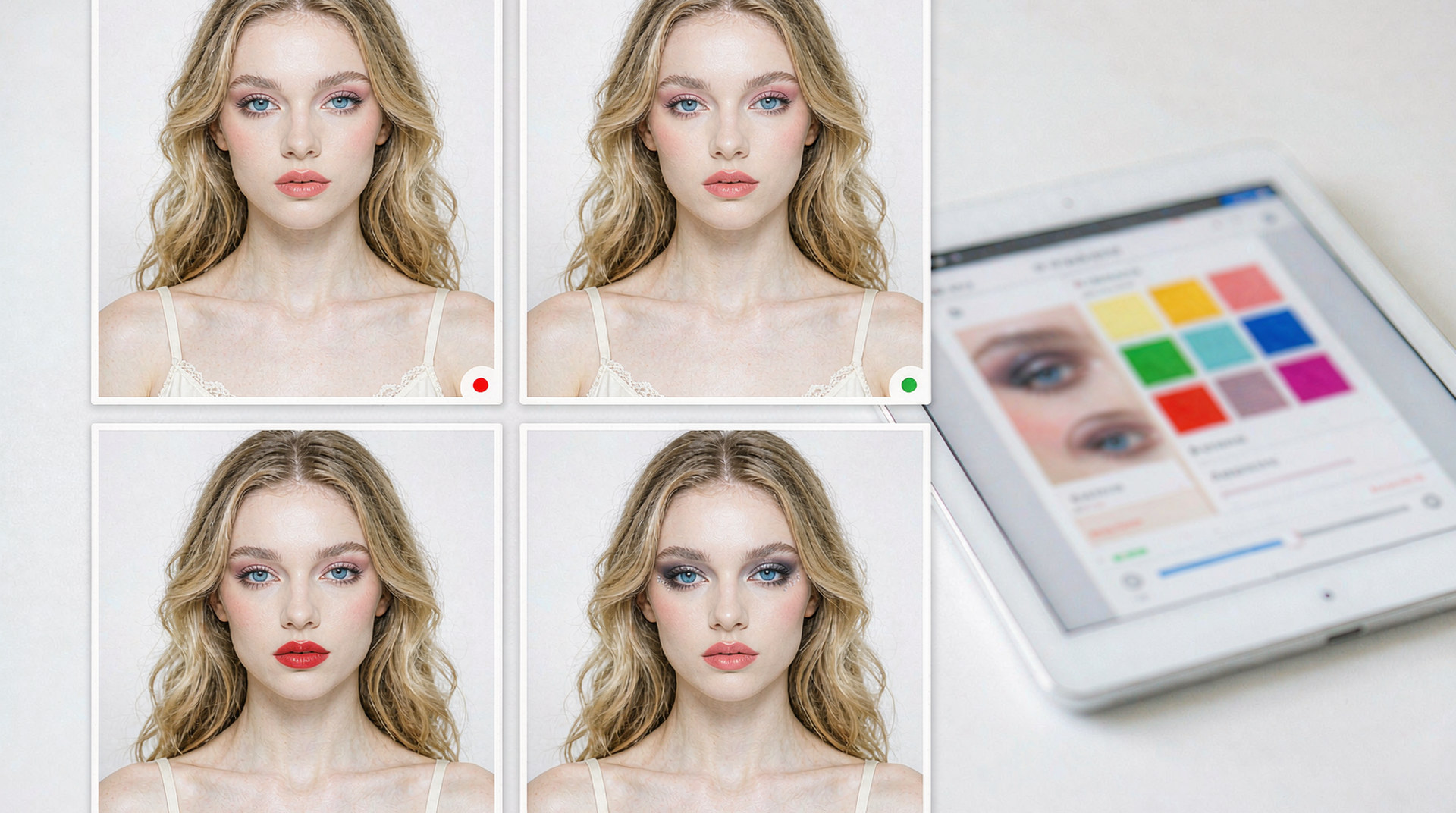
- Beautification and makeup apply live and follow the face through movement, because detection and rendering run per frame without a preprocessing stage.
- Stickers stay attached through head turns — 2D and 3D props anchor to detected facial features and track in real time.
- Background replacement needs no green screen and no manual masking; segmentation runs as part of the same stack.
- Gestures become interactions: a raised hand starts an effect, a wave switches the sticker.
The snippet below is schematic. Names and signatures are illustrative, not the shipped API.
// Illustrative: the five properties composed into one camera session.
import { createEffectsRuntime } from "@meishe/ar-effects"; // placeholder name

const rt = await createEffectsRuntime({ platform: "ios" });
await rt.looks.apply("look.natural.01");       // content, resolved at runtime
await rt.props.attach("prop.crown.party.3d");  // one detection feeds all
4. What the properties mean for your roadmap
A SDK strong on all five keeps your roadmap moving after launch:
- Campaign velocity — new looks and sticker sets ship weekly if you want, because content updates bypass app releases.
- Platform growth — start on mobile, extend to Web and Desktop (Windows); the same packages resolve everywhere.
- Team leverage — designers author in the Asset Creation Platform; Special Effects Customization delivers produced collections when in-house capacity is short.
A stack strong on all five keeps a roadmap moving, and the mechanism is worth naming. Campaigns run at content speed because packages bypass release cycles — the marketing calendar stops queuing behind engineering’s. Platform growth is integration work only, since one package library already resolves on every target. And the authoring load sits with designers in the Asset Creation Platform, with Special Effects Customization absorbing capacity spikes, so engineering stays on product features rather than content porting.
Put together, the five properties compound: cheap updates make more campaigns viable, more campaigns make the content pipeline worth investing in, and the pipeline keeps quality rising while the engine holds the frame budget flat.
5. Why teams choose Meishe
| Advantage | What it means for your project |
|---|---|
| Self-developed engine | Meishe’s own cross-platform audio/video processing engine, developed and refined in-house across the product family |
| Real-time, no pre-processing | Effects the moment the camera opens |
| Small footprint | A small core; optional modules on demand |
| Content pipeline included | Asset Creation Platform and Special Effects Customization keep the library growing |
| Cross-platform coverage | iOS, Android, Web, Desktop (Windows), smart hardware, React Native, Flutter |
6. What shipping teams ask first
- Which of the five matter most for a camera-first app? Real-time rendering and device reach — users feel both within the first session.
- How do we validate “one detection, many effects” in a demo? Stack beauty, a sticker, and a filter together and watch the frame budget — it stays close to flat.
- Who owns package delivery? You do — packages flow through your channel on your schedule.
| Your requirement | What to confirm | Meishe position |
|---|---|---|
| Effects live on the preview | Real-time rendering, no pre-processing | Standard on the shared engine |
| Campaigns without releases | Packages as data | Publish through your own channel |
| Budget phones in the matrix | Adaptive detection cadence | Same package across devices |
| App size discipline | Small core, modules on demand | Around 3 MB core |
| Platform growth | One package library everywhere | Mobile, Web, Desktop (Windows), smart hardware, plus React Native and Flutter |
Take the table into a demo: your footage, your devices, the effects you actually plan to ship. The five properties show up directly in what you see.
Run the same table at quarter-end and it becomes a scorecard: every row either held in production or showed up as a concrete, fixable issue — the kind of traceability vendor demos never provide.
A useful habit: date each row when you check it. The table becomes the project’s memory — new team members see what was verified and when, and quarterly reviews start from evidence instead of impressions.
Between evaluation and production, the five properties keep paying: the same reasons you chose the SDK are the reasons campaigns stay cheap and platforms stay cheap to add.
Ask the same five questions at every renewal, not just the first purchase — products that stay strong on all five after a year in production are the ones worth keeping.
FAQ
How is this different from a feature-list comparison?
Feature lists flatten the differences that matter at runtime. The five properties describe behaviour your users and your frame budget actually feel.
Can we evaluate against our own footage?
Yes — and you should. The SDK resolves your packages on your devices, so a demo on your target material tells you more than any vendor chart.
What does a campaign update involve operationally?
Author or receive the package, publish it through your channel, and every platform picks it up — the binary stays untouched.
Do the five properties apply to streaming as well as capture?
Yes. The camera, the editor timeline, and the live stream resolve the same packages on the same engine.
Where do AI-driven features fit?
Intelligent colour correction and AI-driven modules are optional modules that load on demand — enabled per product, carried only when used.