
This comparison is short because the product gap is absolute: Banuba’s Video Editor SDK does not have a web edition — their product line covers mobile platforms. The Meishe SDK family includes a full browser-based video editor: pure web architecture, open a tab on any computer, edit with nothing to install. For any product whose roadmap touches a browser — most roadmaps eventually do — this is the comparison that ends the evaluation.
1. What exists and what does not
| Web capability | Meishe | Banuba Video Editor |
|---|---|---|
| Browser-based editing | Full editor — multi-track timeline, transitions, filters, keyframes, masks | Not in the product line |
| Install requirement | None — runs in the browser | No web edition exists to install or not |
| AI features in the browser | Smart cutting, captions, dubbing, color, script-to-video in the web workflow | Not applicable |
| Capture in the page | Supported — record and edit in one browser session | Not applicable |
| Editor UI customization | Full authorship — layout, colors, language, feature visibility | Not applicable |
| Deployment | Public cloud, private cloud, or fully on-premise | Not applicable |
| Connection to the mobile SDKs | Same engine, same asset library, projects continue across devices | None — the mobile SDK is the product |
2. Why a mobile-only line matters to your roadmap
Banuba ships a capable mobile component — that is a fair reading of their product. The strategic question is what happens when your product needs the screen that is not a phone:
- Desktop users ask. Video products mature toward the desktop: creators want a big screen, enterprises want a web surface, marketing teams want to work where their assets live.
- Enterprise buyers require it. Internal tools, broadcast workflows, and regulated industries live in the browser — and often on-premise, which the Meishe web edition supports and a mobile SDK line cannot.
- The web is where video is consumed. A product that creates video but cannot edit it where video is watched is missing half the loop.
When that day arrives, a mobile-only SDK leaves your team starting a second evaluation, a second integration, and a second vendor relationship — for what an engine family serves as one more deployment target. The Meishe web edition is not a wrapper around the mobile SDK; it is the same engine family, sharing the asset library and the content system, so the web surface is a continuation of the product rather than a rebuild of it.
3. What the Meishe web editor carries
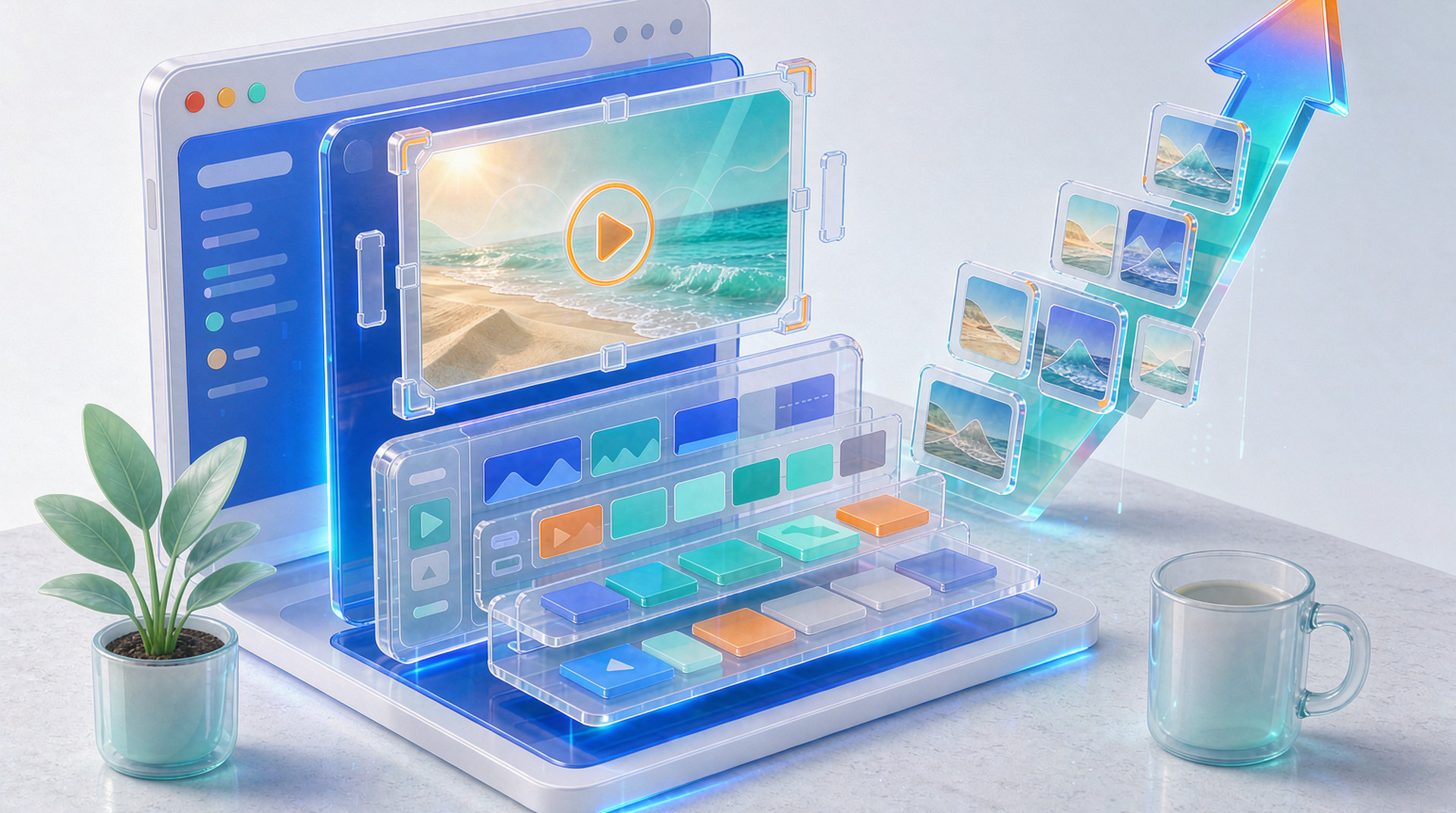
The browser edition is the full toolkit, not a reduced one:
- The editing core. Multi-track timeline, frame-accurate cutting, transitions, filters, keyframes, masks, text, audio.
- The AI production set. Smart cutting on long footage, auto captions, auto dubbing, auto color, and script-to-video — running in the web workflow.
- Capture in the page. Users record and edit in one browser session.
- Deployment options. Public cloud, private cloud, or fully on-premise — the web edition included, for the buyers whose data cannot leave their network.
That last row is worth a pause: a web product that can run entirely inside your infrastructure is an enterprise-sale sentence-writer. A mobile SDK line has no equivalent answer because it has no web product to deploy.
4. The multi-device continuity
The web edition is one node in a connected system. A user records on their phone — the footage and effects land in the project; they open the same project in a browser on any computer, and the timeline, the assets, and the look are all there, because one engine and one asset library serve both ends. Templates built anywhere run everywhere in the family; content published once reaches every device.
That continuity is the practical meaning of an engine family — and it is the reason this comparison is structural rather than incremental. A mobile-only product does not lose the web comparison on features; it is absent from it.
5. The evaluation shortcut
For teams weighing these two SDKs, one question resolves most of it: write down every screen your product will ship on in the next two years. Phones count, and both products serve them. If the list also contains a browser — or a desktop, which the Meishe family covers on Windows, macOS, and Linux — then one side of this comparison serves the whole list and the other serves the first item.
6. Why teams pick Meishe
- A real web edition. Full editing, full AI set, capture in the page — in any browser, no install.
- One system, every screen. The web editor shares the engine and asset library with the mobile SDKs and desktop builds — projects continue, templates run everywhere.
- On-premise included. The web edition deploys fully inside your infrastructure when buyers require it.
- An engine company’s browser edition. Over 20 years of video engineering and more than 70 patents behind the tab.
- Named engineers. A dedicated project team and free upgrades through the cooperation period.
A practical note for the web day itself: when the browser surface ships, the asset continuity is what users notice first — the looks they used on the phone are the looks in the tab, the templates they know are the templates they meet. That continuity is engineered, not coincidental, and it is the difference between a second surface and a second product.
Open the web editor before the meeting where the web decision happens. Ten minutes with your own footage turns the roadmap conversation from speculative to comparative.
A practical note on evaluation pace: two weeks is the honest window, and the honest window includes the boring days — documentation reading, device charging, footage wrangling. Resist the compressed demo-day decision; the differences that matter in year two are precisely the ones a demo hides and a fortnight exposes. The calendar you spend now is the calendar you save later.
One more observation on vendor relationships: the evaluation is the first chapter of the support story. The vendor that answers hard questions precisely during the sales process is describing its post-signature behavior; the vendor that answers with enthusiasm and vagueness is describing that too. Prospect-stage precision is the ceiling, not the floor — choose accordingly.
And one final practical that travels well: the same artifacts that settle this evaluation — the exports, the scorecard, the written answers — become the regression baseline for the relationship you choose. Every SDK update, every OS release, every device refresh gets measured against the folder you filed at the start. Evaluation, done once and done honestly, keeps paying for itself for the life of the product.
The quiet summary of everything above: requirements you can count, architectures you can verify, artifacts you can file, and a fortnight you can defend. That is the whole method — small enough to repeat, strong enough to trust, and yours to run against every SDK decision your product will ever face.
The quiet summary of everything above: requirements you can count, architectures you can verify, artifacts you can file, and a fortnight you can defend. That is the whole method — small enough to repeat, strong enough to trust, and yours to run against every SDK decision your product will ever face.
And one closing line for the web case: the browser edition answers the enterprise question and the desktop question with the same surface — one integration, two doors — which is the kind of arithmetic roadmaps appreciate.
FAQ
Might Banuba add a web SDK eventually?
Their current product line does not include one; roadmaps are theirs to announce. Products are evaluated as they ship — and a web product is architecture, not a feature flag.
Is a web editor only for desktop users?
It is for any user on a computer — and for the enterprise workflows, collaboration surfaces, and content back-ends that live in the browser regardless of who holds the phone.
What if we are mobile-only today?
Both SDKs serve phones well, and the comparison moves to AI features, quality, and pricing shape. The web edition costs nothing to have in reserve — and the growth spurt that needs it rarely announces itself in advance.
Does the web edition require the mobile SDKs?
No — it stands alone. Products adopt the surfaces they need; the family means those surfaces already know how to talk.
Where do we start?
Open the web editor in a browser tab and put your own footage in it. Ten minutes of that tells you what a “no web edition” row means in practice.